
堅田研究室へ、ようこそ


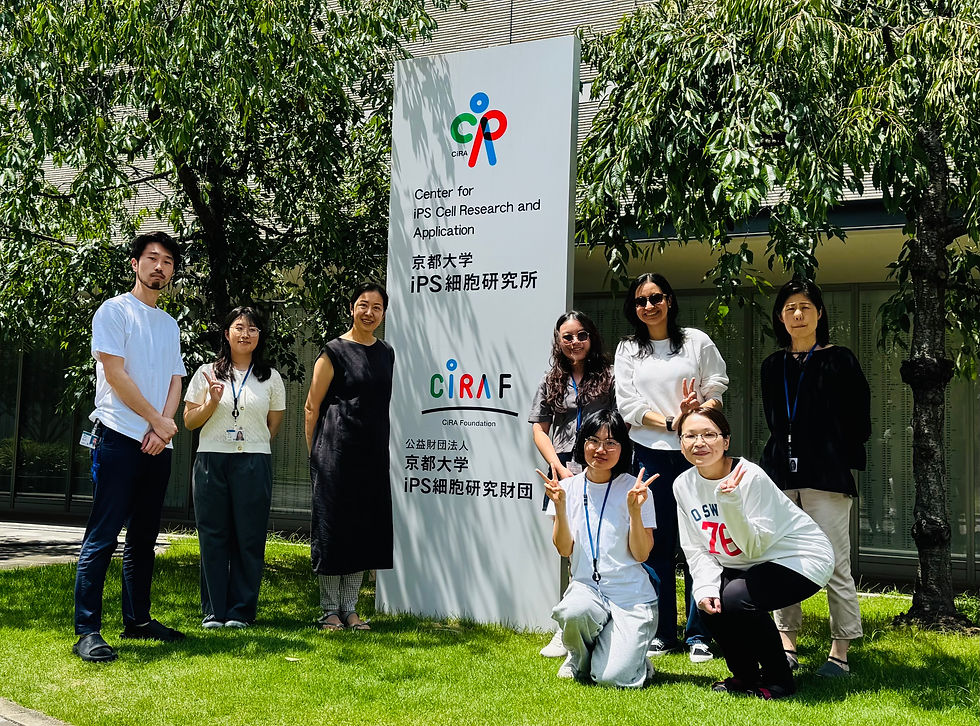
2025年9月に発足しました。
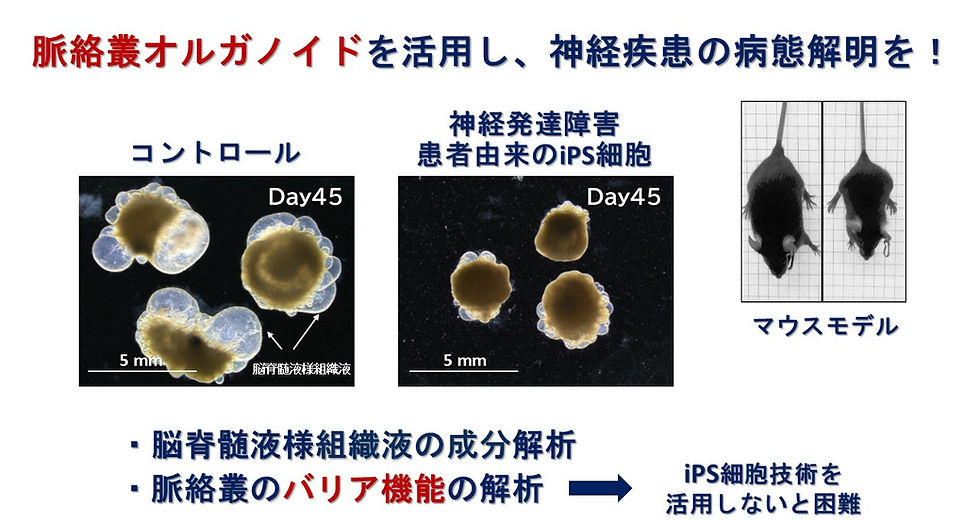
iPS細胞技術とマウスモデルを活用し、脳の隠れた組織である脈絡叢から脳の発生と発達、また神経疾患の病態解明を目指します。

新着情報 / News
2026/08/27 高校3年生をお招きし、堅田・山下が研究やキャリアパスを紹介する特別セミナーを開催しました。
2026/08/26 大阪大学から学生を迎え、2週間のインターンシップがスタートしました。
2026/06/08 ドイツ・ミュンヘン大学から学生を迎え、1か月間のインターンシップがスタートしました。
2026/05/31 iPS細胞20周年記念 公開シンポジウムで堅田が講演、山下がポスター発表させて頂きました。
2026/04/01 助教:山嵜絵海、特別研究学生:Kelren Rodrigues、研究生:楊玉婷が研究室に加わりました。
2026/03/14 第19回神経発生討論会@京都工業繊維大学で、Kelren Rodriguesが発表しました。
2026/01/01 研究員:山下りえが堅田研究室に加わりました。
2025/12/04 第48回日本分子生物学会年会「加齢に伴う器官変容のメカニズム」で、堅田が発表しました。
2025/11/04 第98回日本生化学会大会「細胞内外のオルガネラが織りなす多彩な脳内制御」で、堅田が発表しました。
2025/10/01 九州大学からの研究指導委託学生として、魚津孝允、有村崚が加わりました。
2025/09/27 中日バイオ医療・生命科学技術と産業融合フォーラムにて、堅田が発表しました。
2025/09/01 京都大学iPS細胞研究所 増殖分化機構研究部門に堅田研究室が発足しました。
The Hidden Tissue of the Brain:
Tackling Neurological Disorders through the Choroid Plexus
-脳の隠れた組織: 脈絡叢から神経疾患に挑む-
Research
Projects

脳発生
脈絡叢がつくる脳脊髄液環境は、胎生期の脳発生を支える重要なシグナル供給源です。私たちの研究室では、脈絡叢から分泌される栄養因子や増殖因子が、神経幹細胞の一次繊毛を介してどのように受容され、細胞運命や脳皮質形成を制御しているのかを研究しています。シングルセルマルチオーム解析を活用することで、個々の神経幹細胞が外界の情報をどのように読み取り、発生プログラムへと変換するのかを明らかにし、脳発生の新たな理解を目指します。
恒常性維持
成体において脈絡叢は、血液脳脊髄液関門(Blood–CSF Barrier)として脳内環境の恒常性維持に重要な役割を担っています。脈絡叢内の血管は物質透過性の高い有窓性血管内皮により構成されており、その代わりに脈絡叢上皮細胞が脳への物質移行を厳密に制御しています。このバリア機能は脳の正常な働きを支えるだけでなく、近年では脳への薬剤送達経路としても注目されています。私たちの研究室では、iPS細胞由来脈絡叢オルガノイドを用いてヒトの血液脳脊髄液関門を再現し、そのバリア機能や物質輸送機構、さらには創薬への応用可能性について研究を進めています。
老化・神経疾患
脈絡叢は脳の発達や恒常性維持に不可欠な組織であり、その遺伝的変化や加齢に伴う機能低下は、神経機能に大きな影響を及ぼすことが分かってきました。私たちの研究室では、患者さん由来のiPS細胞から作製した脈絡叢オルガノイドや疾患モデルマウスを活用し、脈絡叢の異常が神経疾患にどのように関与するのか、その分子メカニズムの解明に取り組んでいます。さらに、脈絡叢を新たな治療標的と捉え、その機能を回復・制御することで、神経疾患の新たな治療法の開発を目指しています。

Publications
Rodrigues K, Yamashita R, Katada S*
“The choroid plexus-cerebrospinal fluid axis as a lifespan regulator of neural stem cells and circuit plasticity”
Frontiers in Neural Circuits, 2026; 20:1818927 DOI:10.3389/fncir.2026.1818927
Katada S, Rodrigues K, Nakashima K*
“The influence of the choroid plexus on brain function: beyond its role in cerebrospinal fluid production”
Inflamm. Regen., 2025; 45(1):20 DOI:10.1186/s41232-025-00386-1
Nakagawa T, Hata K, Izumi Y, Nakashima H, Katada S, Matsuda T, Babba T, Nakashima K*
“E3 ubiquitin ligase RMND5A maintains the self-renewal state of human neural stem/precursor cells by regulating Wnt and mTOR signaling pathways”
FEBS Letters, 2025;599:10 DOI:10.1002/1873-3468.70067
Uotsu T, Nakashima K, Katada S*
“Multifaceted regulation of neural stem cell fate in the developing brain”
European Society of Medicine, 2024; 12: 1-17.
Uchihara Y, Sato H, Kawabata-Iwakawa R, Katada S, Gu W, Kakoti S, Yamauchi M,
Kato R, Gondhowiardjo S, Hosen N, Yasuhara T, & Shibata A*
“DNA damage promotes HLA class I presentation by stimulating a pioneer round of translation associated antigen production”
Mol Cell, 2022; 82: 2557-70. DOI: 10.1016/j.molcel.2022.04.030
Katada S*, Takouda J, Nakagawa T, Honda M, Igarashi K, Imamura T, Ohkawa Y,
Sato S, Kurumizaka H, & Nakashima K*
“Neural stem/precursor cells dynamically change their epigenetic landscape to differentially respond to BMP signaling for fate switching during brain development”
Genes & Development, 2021; 35: 1431-44. DOI:10.1101/gad.348797.121
Wittmann MT, Katada S, Sock E, Kirchner P, Ekici A, Wegner M, Nakashima K, Lie DC*, & Reis A*
“scRNA sequencing uncovers a TCF4-dependent transcription factor network regulating commissure development in mouse”
Development, 2021; 148: Dev196022. DOI: 10.1242/dev.196022.
Takouda J, Katada S*, Imamura T, Sanosaka T & Nakashima K*
“SoxE group transcription factor Sox8 promotes astrocytic differentiation of neural stem/precursor cells downstream of Nfia”
Pharmacol Res. & Perspectives, 2021; 9: e00749. DOI: 10.1002/prp.2.749.
Nguyen QAT, Hillis D, Katada S, Harris T, Pontrello C, Garland T & Haga-Yamanaka S*
“Coadaptation of the chemosensory system with voluntary exercise behavior in mice”
PLOS ONE, 2020; 15: e0241758. DOI: 10.1371/journal.pone.0241758.
Nakagawa T, Wada Y, Katada S*, & Kishi Y*
“Epigenetic regulation for acquiring glial identity by neural stem cells during cortical development”
Glia, 2020; 68: 1554-1567. DOI: 10.1002/glia.23818.
Kawamura Y, Katada S, Noguchi H, Yamamoto H, Sanosaka T, Iihara K, Nakashima K*
“Synergistic induction of astrocytic differentiation by factors secreted from meninges in the mouse developing brain”
FEBS Letters, 2017; 591: 3709-3720. DOI: 10.1002/1873-3468.12881.
Honda M, Nakashima K, & Katada S*
“PRMT1 regulates astrocytic differentiation of embryonic neural stem/precursor cells”
J Neurochem., 2017; 142: 901-907. DOI: 10.1111/jnc.14123.
Takouda J, Katada S, & Nakashima K*
“Emerging mechanisms underlying astrogenesis in the developing mammalian brain”
Pro Jpn Acad Ser B Phys Biol Sci., 2017; 93: 386-398. DOI: 10.1007/978-3-319-93485-3_5.
Aguilar-Arnal L, Katada S, Oroco-Solis R, & Sassone-Corsi P*
“NAD-SIRT1 control of H3K4 trimethylation through circadian deacetylation of MLL1”
Nat Struct Mol Biol., 2015; 22: 312-318. DOI: 10.1038/nsmb.2990.
Kaneko-Goto T#, Sato Y#, Katada S#, Kinameri E, Yoshihara S, Nishiyori A, Kimura M, Fujita H, Touhara K, Reed RR & Yoshihara Y* (# equally contributed)
“Goofy coordinates the acuity of olfactory signaling”
J Neurosci., 2013; 33: 12987-12996. DOI: 10.1523/JNEUROSCI.4948-12.2013.
Katada S, Imhof A, & Sassone-Corsi P*
“Connecting Threads: Epigenetic and Metabolism”
Cell, 2012; 148, 24-28. DOI: 10.1016/j.cell.2012.01.001.
Masri S, Zocchi L, Katada S, Mora E, & Sassone-Corsi P*
“The circadian clock transcriptional complex: metabolic feedback intersects with epigenetic control”
Anal NY Acad Sci., 2012; 1264, 103-109. DOI: 10.1111/j.1749-6632.2012.06649.x.
Katada S & Sassone-Corsi P*
“The histone methyltranferase MLL1 permit the oscillation of circadian gene expression”
Nat Struct Mol Biol., 2010; 17: 1414-1421. DOI: 10.1038/nsmb.1961.
Grimaldi B, Bellet MM, Katada S, Astarita G, Hirayama J, Amin RH, Granneman JG, Piomeli D, Leff T, & Sassone-Corsi P*
“Per2 controls lipid metabolism by direct regulation of PPARg”
Cell Metab., 2010; 12: 509-520. DOI: 10.1016/j.cmet.c010.10.005.
Kato A, Katada S, & Touhara K*
“Amino acids involved in conformational dynamics and G protein coupling of an odorant receptor: targeting gain-of-function mutation”
J Neurochem., 2008; 107: 1261-70. DOI: 10.1111/j.1471-4159.2008.05693.x.
Katada S, Hirokawa T, & Touhara K*
“Exploring the odorant binding site of a G-protein-coupled olfactory receptor”
Curr Comput Aided Drug Des., 2008; 4, 123-131. DOI: 10.2174/157340908784533247
Oka Y, Katada S, Omura M, Suwa M, Yoshihara Y, & Touhara K*
“Odorant receptor map in the mouse olfactory bulb: in vivo sensitivity and specificity of receptor-defined glomeruli”
Neuron, 2006; 52: 857-69. DOI: 10.1111/j.1471-4159.2008.05693.x.
Katada S, Hirokawa T, Oka Y, Suwa M, & Touhara K*
“Structural basis for a broad but selective ligand spectrum of a mouse olfactory receptor: mapping the odorant-binding site”
J Neurosci., 2005; 25: 1806-15. DOI: 10.1523/JNEUROSCI.4723-04.2005.
Katada S, Tanaka M, & Touhara K*
“Structural determinants for membrane trafficking and G protein selectivity of a mouse olfactory receptor”
J Neurochem., 2004; 90: 1454-63. DOI: 10.1111/j.1471-4159.2004.02619.x.
Katada S, Nakagawa T, Kataoka H, & Touhara K*
“Odorant response assays for a heterologously expressed olfactory receptor”
Biochem Biophys Res Commun. 2003; 305: 964-9. DOI: 10.1016/s0006-291x(03)00863-5.
和文総説(抜粋)
魚津孝允、堅田明子
“脳内液性環境を司る脈絡叢:脳発生と機能調節”
実験医学 2025; 43:14
堅田明子
“健康寿命を最大限に延ばす秘訣は自然のなかにあり!”
実験医学 2024; 42: 2235-38
堅田明子、中島欽一
“幹細胞分化制御の鍵を握るエピジェネティクス”
細胞 2012; 8: 11-14.